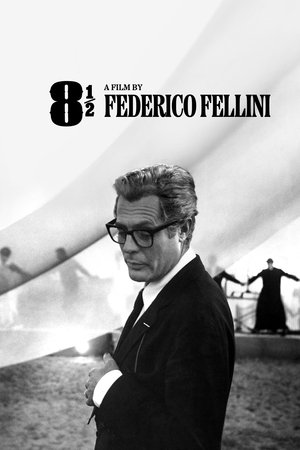
8½ (1963)
8.09 /10
2535 Reviews
Rate This Movie:
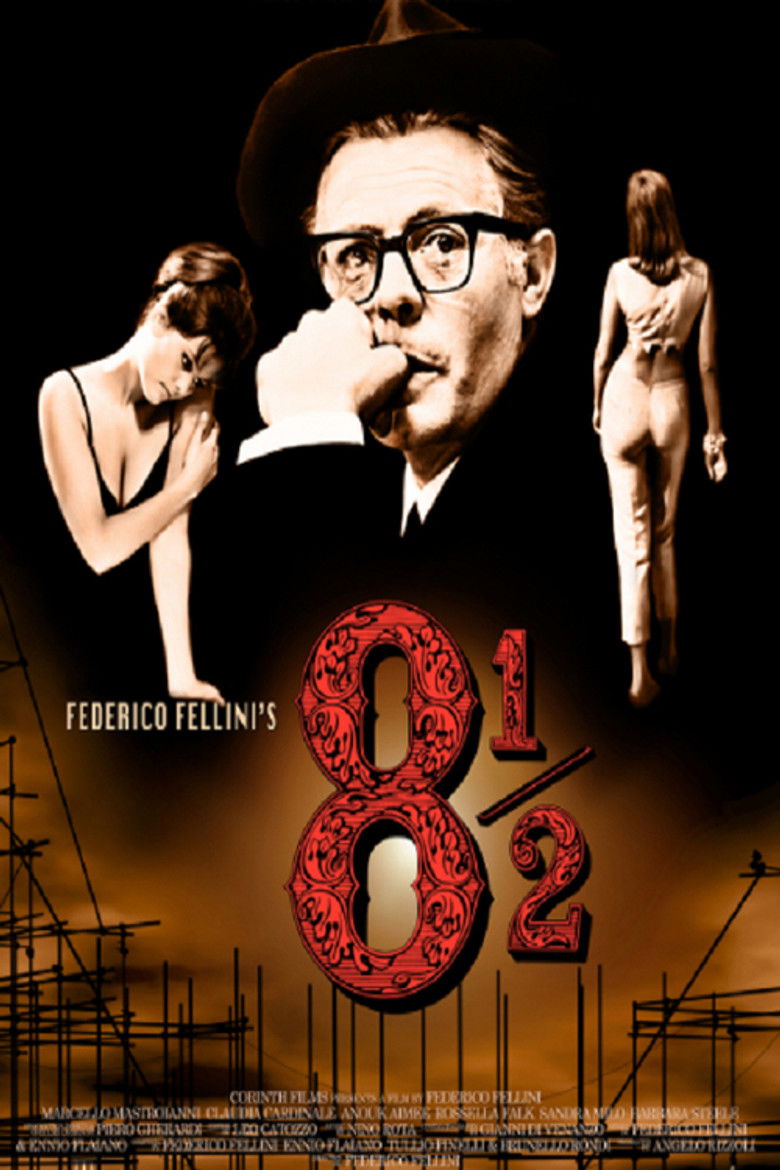
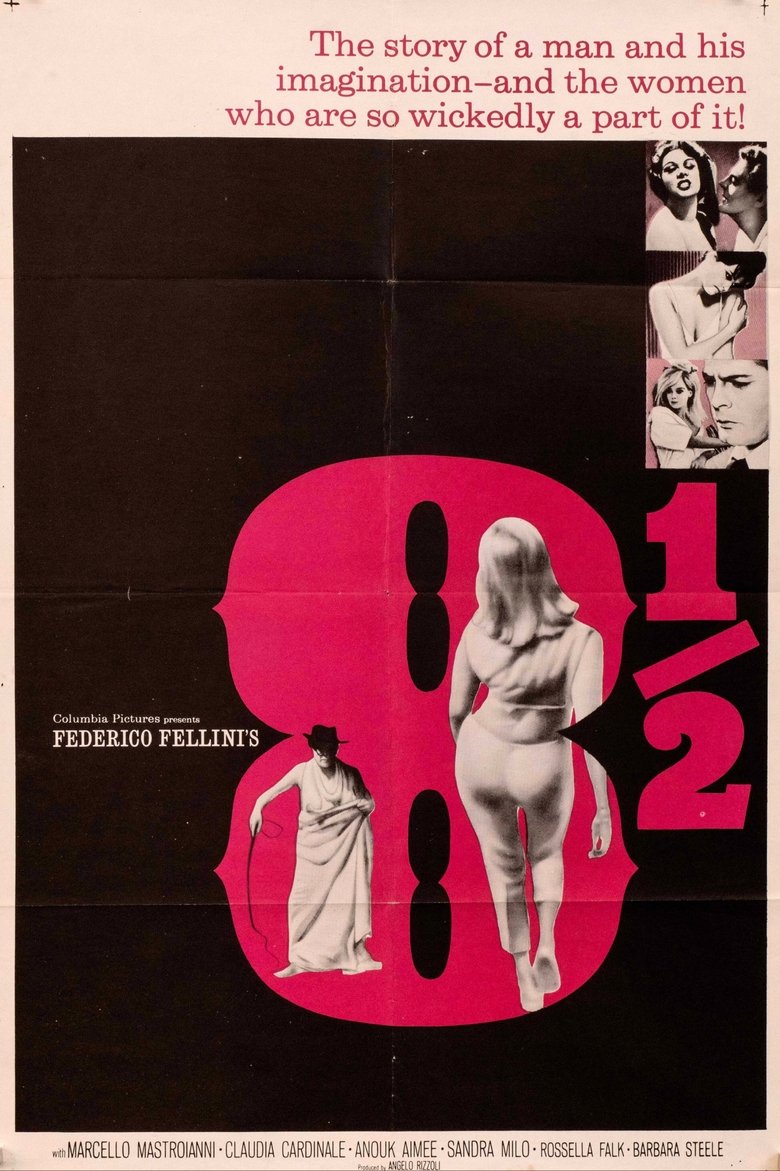
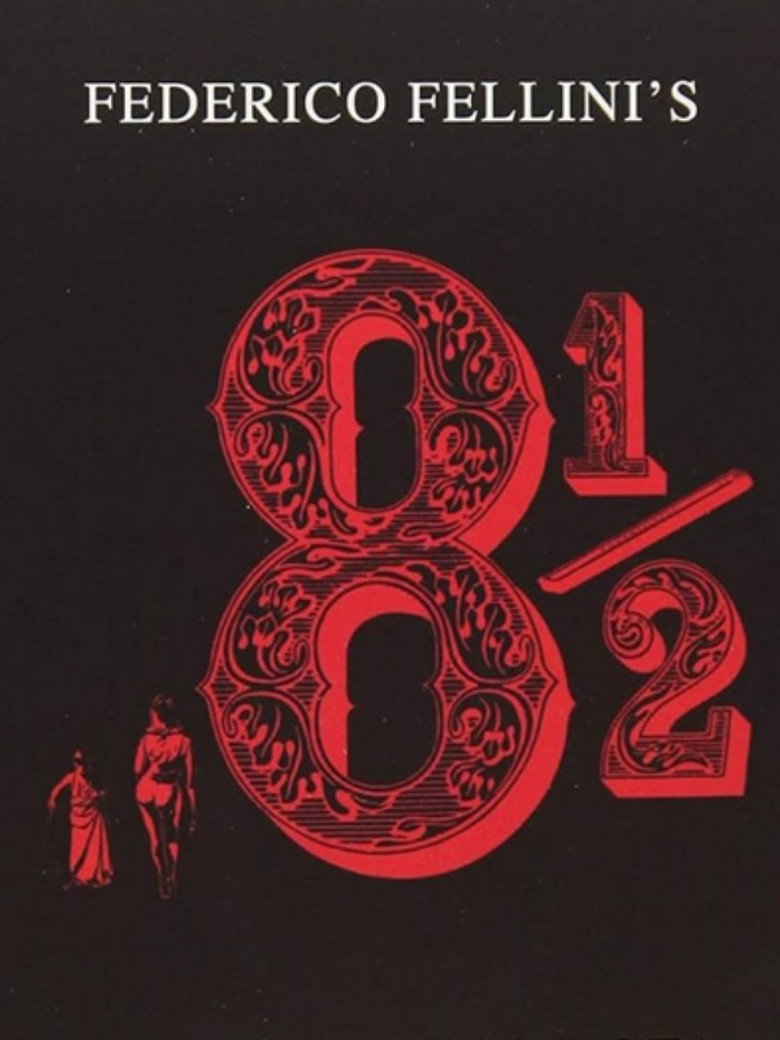
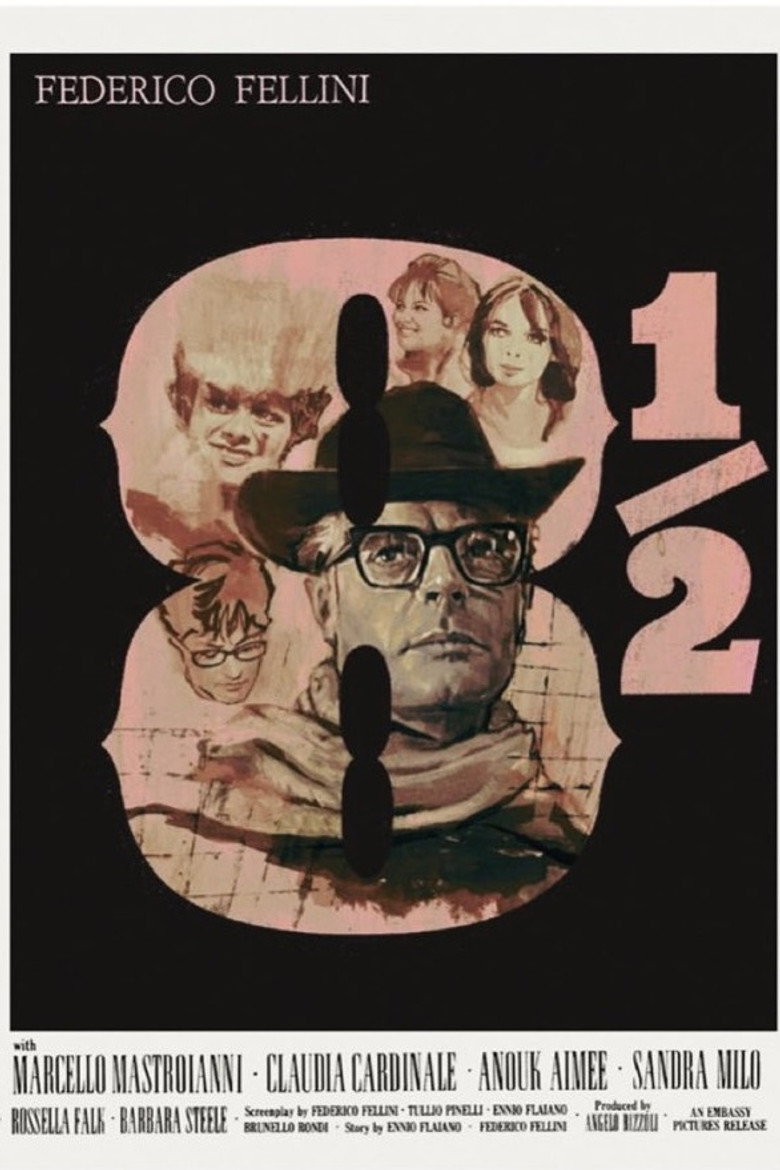
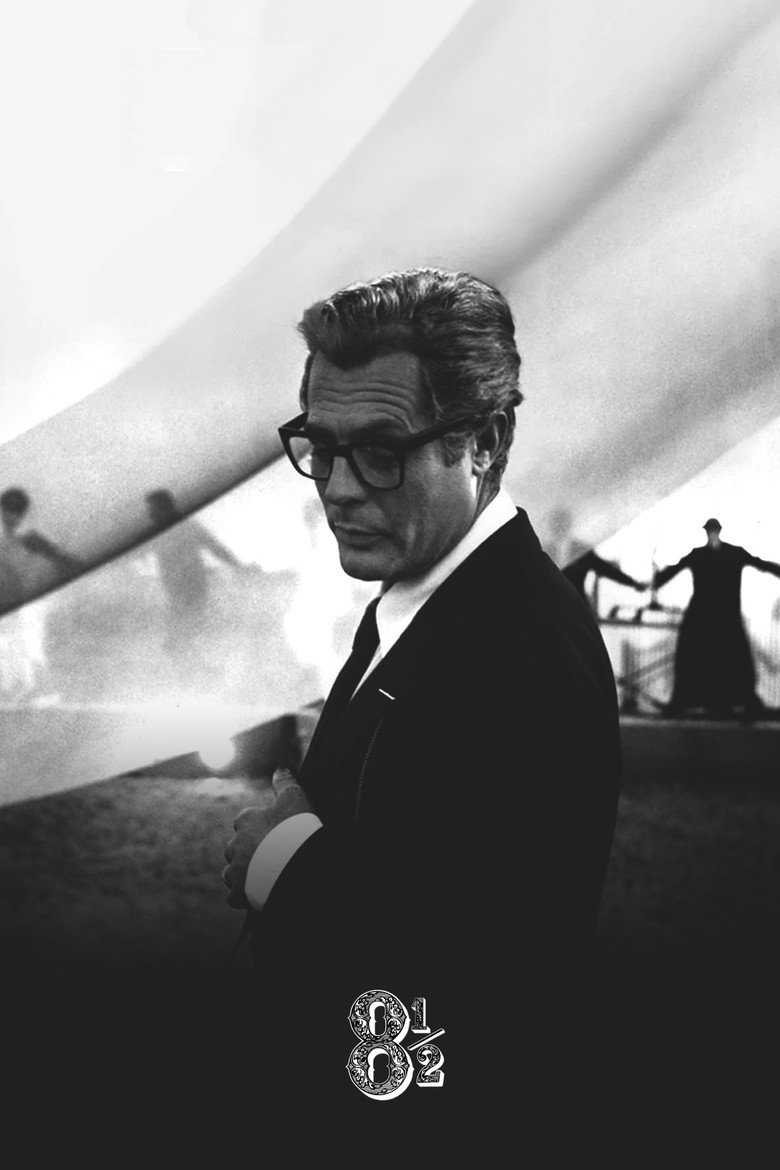
Guido Anselmi, a film director, finds himself creatively barren at the peak of his career. Urged by his doctors to rest, Anselmi heads for a luxurious resort, but a sorry group gathers—his producer, staff, actors, wife, mistress, and relatives—each one begging him to get on with the show. In retreat from their dependency, he fantasizes about past women and dreams of his childhood.
Videos & Photos


cast

... Guido Anselmi

... Claudia

... Luisa Anselmi

... Carla

... Rossella
User reviews
Widely touted as one of the all-time great works of cinema, Federico Fellini’s 8½ is an elusive film about even more elusive things. It’s a meaningfully chaotic picture about trying to distil meaning from chaos and it’s a creative success about creative failure. It chronicles the resonant moments in one man’s life and admits that it can’t quite clarify why they matter. Doing justice to its early working title of The Beautiful Confusion, 8½ is a daring high wire act and an outstanding technical achievement that channels its story of artistic crisis into something sweepingly, uniquely profound.
Working again under Fellini’s direction after his winning performance in La Dolce Vita, Marcello Mastroianni plays Guido, a creatively blocked director feeling constantly distracted from the development of his latest semi-autobiographical work. Between avoiding his mistress (Sandra Milo) and disappointing his wife (Anouk Aimée), Guido spends time reflecting on his past, searching for answers and escaping into fantasies. The narrative seamlessly weaves in and out of Guido’s dreams and memories, to the point that it becomes impossible to distinguish real from imagined. The actress named Claudia, tellingly played by the legendary Claudia Cardinale, seems especially intangible, generally appearing only fleetingly in Guido’s visions playing the woman in his film that Guido intends to be a symbol of purity, innocence and redemption. The story, in a sense, is a mess but a brilliantly orchestrated mess that skilfully highlights the mysteries and confusions of life and the human psyche. Characters suddenly enter the narrative then leave before you’ve even noticed they’re gone because the film is confined within the periphery of Guido’s life. What these supporting players actually do isn’t as important as the impressions that they make. They’re all just additions to the fabric of the filmmaker’s mind.
This perception of the world is completely in tune with the engrossingly complex lead’s own self-involved view, seeing everyone he crosses paths with as a supporting player in his existence, rather than a fully-rounded individual with a long, complicated life of their own. Guido lacks awareness of the emotional impact of his actions and underestimates his own transparency, not realising when people detect his deceptions and cowardly evasions. His wife, Luisa, in particular seems more observant of Guido’s fraudulent nature than even Guido.
It’s made abundantly clear from the film’s choice of protagonist and its title (8½ being Fellini’s count of the number of films he’d made so far) that this film was meant to be viewed at least in part as a very personal work from the director. But if the weary half-heartedness of Guido’s filmmaking is meant to reflect Fellini’s own exhaustion, it’s evident that the director had got his groove back by the time shooting began. Every shot seems perfectly placed and every cut is perfectly timed for the film to fold out with effortless cohesion, like one extended monologue. Fellini hardly wastes a square inch of a single frame, saturating (but not over-saturating) his backgrounds with rhythmic movement and entrancing production design. His thoughtfully precise camera creates inexhaustible space, extending rooms by their mirrors and constructing distinct layers to the crowded environments he observes. This may well be the best directed film of Fellini’s celebrated career.
8½ remains one of those rare feats of cinema that have proved highly influential (acclaimed descendants from recent years include Charlie Kaufman’s Synecdoche, New York and Paolo Sorrentino’s The Great Beauty) and yet still wholly unique. Even Fellini himself never made another work that so gracefully blended irony with sincerity, surreality with relatability and ambiguity with insightfulness, but once was enough. This richly intricate film is built to be endlessly re-seen, enjoyed and puzzled over. The final paradox of 8½ is that it refutes itself. Apparently when a great director doesn’t know what kind of film he wants to make, he makes a masterpiece.
Written by David Pountain
Watch '8½' at FilmDoo.com now (UK & Ireland Only)
Director:
Writer:
Ennio Flaiano (Screenplay)
Tullio Pinelli (Screenplay)
Brunello Rondi (Screenplay)
Federico Fellini (Screenplay)
Ennio Flaiano (Story)
Federico Fellini (Story)
Genres:
Release Date:
1963-02-14
Run Time:
139 min
MMPA Rating:
NR
Reviews of
8½
Widely touted as one of the all-time great works of cinema, Federico Fellini’s 8½ is an elusive film about even more elusive things. It’s a meaningfully chaotic picture about trying to distil meaning from chaos and it’s a creative success about creative failure. It chronicles the resonant moments in one man’s life and admits that it can’t quite clarify why they matter. Doing justice to its early working title of The Beautiful Confusion, 8½ is a daring high wire act and an outstanding technical achievement that channels its story of artistic crisis into something sweepingly, uniquely profound.
Working again under Fellini’s direction after his winning performance in La Dolce Vita, Marcello Mastroianni plays Guido, a creatively blocked director feeling constantly distracted from the development of his latest semi-autobiographical work. Between avoiding his mistress (Sandra Milo) and disappointing his wife (Anouk Aimée), Guido spends time reflecting on his past, searching for answers and escaping into fantasies. The narrative seamlessly weaves in and out of Guido’s dreams and memories, to the point that it becomes impossible to distinguish real from imagined. The actress named Claudia, tellingly played by the legendary Claudia Cardinale, seems especially intangible, generally appearing only fleetingly in Guido’s visions playing the woman in his film that Guido intends to be a symbol of purity, innocence and redemption. The story, in a sense, is a mess but a brilliantly orchestrated mess that skilfully highlights the mysteries and confusions of life and the human psyche. Characters suddenly enter the narrative then leave before you’ve even noticed they’re gone because the film is confined within the periphery of Guido’s life. What these supporting players actually do isn’t as important as the impressions that they make. They’re all just additions to the fabric of the filmmaker’s mind.
This perception of the world is completely in tune with the engrossingly complex lead’s own self-involved view, seeing everyone he crosses paths with as a supporting player in his existence, rather than a fully-rounded individual with a long, complicated life of their own. Guido lacks awareness of the emotional impact of his actions and underestimates his own transparency, not realising when people detect his deceptions and cowardly evasions. His wife, Luisa, in particular seems more observant of Guido’s fraudulent nature than even Guido.
It’s made abundantly clear from the film’s choice of protagonist and its title (8½ being Fellini’s count of the number of films he’d made so far) that this film was meant to be viewed at least in part as a very personal work from the director. But if the weary half-heartedness of Guido’s filmmaking is meant to reflect Fellini’s own exhaustion, it’s evident that the director had got his groove back by the time shooting began. Every shot seems perfectly placed and every cut is perfectly timed for the film to fold out with effortless cohesion, like one extended monologue. Fellini hardly wastes a square inch of a single frame, saturating (but not over-saturating) his backgrounds with rhythmic movement and entrancing production design. His thoughtfully precise camera creates inexhaustible space, extending rooms by their mirrors and constructing distinct layers to the crowded environments he observes. This may well be the best directed film of Fellini’s celebrated career.
8½ remains one of those rare feats of cinema that have proved highly influential (acclaimed descendants from recent years include Charlie Kaufman’s Synecdoche, New York and Paolo Sorrentino’s The Great Beauty) and yet still wholly unique. Even Fellini himself never made another work that so gracefully blended irony with sincerity, surreality with relatability and ambiguity with insightfulness, but once was enough. This richly intricate film is built to be endlessly re-seen, enjoyed and puzzled over. The final paradox of 8½ is that it refutes itself. Apparently when a great director doesn’t know what kind of film he wants to make, he makes a masterpiece.
Written by David Pountain
Watch '8½' at FilmDoo.com now (UK & Ireland Only)
**Fellini, deconstructed, improvised and enshrined in a film that (not) pleases everyone.**
I'm not a fan or deep connoisseur of Italian cinema, but I've heard of Federico Fellini, and I know that this film is considered one of this director's best films. I haven't seen any of his films yet: this was the first. And honestly, I don't quite understand this fascination: the film is chaotic! I think that, unless someone is an expert in cinema, the vast majority of people who saw the film did not understand it, but then said that it was very good just to avoid being criticized. I'm glad I don't give a damn what other people think of me...
Fellini was out of great ideas, and the production started working without even having an idea of what the director was going to do. Not even he knew! He was about to give up when the light came: to make a somewhat autobiographical film about a filmmaker in crisis, who had to make a film due to studio commitments, but didn't know what film he wanted to make. Let's face it: it was an excellent idea, even if it resulted in a film that is too complicated and disjointed. Over the course of more than two hours, we see scenes and situations in which the director reflected a lot about himself in the main character: the complicated issues with a restrictive and judgmental Catholic faith, strong moral conflicts, a rebellious childhood, the omnipresence of impactful female figures (the mother, the wife, the objects of desire)… everything is composed as a delirium of a filmmaker empty of ideas. For the time, this was quite innovative, but looking closely today, it doesn't make much sense and is more tiring than interesting.
Technically, the film is excellent. The soundtrack, by Nino Rota, is quite atmospheric; the cinematography, with the framing, the differences in shot and sharpness, is an authentic lesson taught by a master. The choice of filming locations and sets is careful. Marcello Mastroianni and Claudia Cardinale are the most notable actors in the film, but they both have better works and I don't feel that this film is worth seeing because of them. But what really tired me was the artificiality of the dubbed dialogues: Fellini liked to film with noise (he's like that college students who like to study in crowded cafeterias), and the actors often improvised their lines over a sketch that was given at this moment, so all the dialogues were dubbed and arranged in post-production. The result is surreally strange and fake, with the movement of the mouth not matching what we are hearing.
Yes, this is one of the great works of Italian cinema, that's for sure, and when we see these points analyzed we can understand it better. But it is not the type of film that the general public wants to see, and it ended up being left to an intellectualist and hermetic elite, who like to treat cinema as their thing, with an almost mystical sort of knowledge that cannot be passed on to any mortal. I don't care about that, or what anyone calls me: films like that are good for sleeping.
Acclaimed director "Guido" (Marcello Mastroianni) is looking for a peaceable life after his last successful movie, but at every turn he is being pursued by people who want to capitalise on the success. He just hasn't the inspiration though - and determined not to just churn out any old rubbish, retreats to a small town for some rest, recuperation and hopefully inspiration. He in also rather reaping what he sowed as his wife "Luisa" (Anouk Aimée) and her rival "Claudia" (Claudia Cardinale) are vying for his increasingly frayed attentions and that makes any chance of concentration almost impossible. What happens now? Actually that's not so important to the thrust of the plot. What's a little more engaging here is a sort of hybrid illustrating the foibles of those creatives desperate for and addicted to the whole process of making a film as well as all of them demonstrating just how difficult it can be to actually produce a feature film. The narrative is also quite confusing at times with chronologies blurring and timelines being adapted as if on a whim - and those whims aren't always immediately clear to us who watch on bemusedly. There's something natural about the characterisations too. The venal, the aspirational, the lovelorn, the lovestruck - and the director who is genuinely swimming through a series of doldrums from which he cannot readily escape. The intensity never really lets up - indeed every time you see Guido Alberti - his long-suffering producer "Pace" you almost want to weep for a "Guido" under the sort of relentless pressure usually reserved for the father of a family of two hundred dependents. Mastroianni juggles the balls required for this part skilfully and by the mid point of this 2¼ cinema curiosity I felt a degree of his physical and emotional exhaustion visited on me, too! Nino Rota could always be relied upon provide a solid score - and here he reflects the mood of the story and it's personalities with an eclectic series of themes that range from the adagio to an entertaining Italian version of a grand scale hokey cokey. There's maybe just a little too much dialogue for me here. It's all pretty break-neck paced anyway, and occasionally I did just want them all to shut up - but this is still a potpourri of ideas and personae that offers an amusing look at film making and film makers alike.
Cast & Crew of
8½
Cast
... Guido Anselmi
... Claudia
... Luisa Anselmi
... Carla
... Rossella

... Gloria Morin

... Madeleine, the French Actress

... Mysterious Lady

... La Saraghina

... Pace, the Producer

... Conocchia, the Production Manager

... Bruno, the Second Production Secretary

... Cesarino, the Production Supervisor

... Carini, the Film Critic

... Mario Mezzabotta

... Jacqueline Bonbon
... Maurice, Maya's Assistant

... Claudia's Agent

... Nadine, the Hostess

... Guido's Grandmother

... Hedy, The Model
... The Cardinal

... Producer's Friend

... Luisa's Friend

... Luisa's Suitor
... Guido's Aunt
... The French Actress's Agent
... Matilde, Luisa's Sister

... The American Journalist
... La negretta

... American Journalist's Wife
... Claudia's Press Office
... Maya, the Clairvoyant
... The Lay Secretary
... Luisa's Friend

... A Friend
... Guido as a Child

... Guido's Mother

... Guido's Father

... Dina (uncredited)
... Eva (uncredited)

... School Director (uncredited)
... A Man in a Car (uncredited)
... A Man in the Mud (uncredited)

... Young Priest (uncredited)

... Olimpia (uncredited)

... (uncredited)

... Luisa's Friend (uncredited)

... Priest Teacher (uncredited)

...
Crew

... Screenplay

... Screenplay
... Screenplay

... Producer

... Original Music Composer

... Director

... Director of Photography
... Screenplay
... Unit Manager
... Line Producer
... Production Manager

... Assistant Production Design
... Story
... Assistant Editor
... Sound
... Story
... Second Assistant Director
... Assistant Costume Designer

... Makeup Department Head
... Production Manager
... Sound
... Production Secretary
... Script Supervisor
... First Assistant Director

... Camera Operator
... Second Assistant Director

... Production Secretary
... Set Decoration
... Costume Design
... Production Design
... Hair Designer

... Editor
Videos & Photos of
8½
Videos (4)
![35mm Trailer [Subtitled]](https://img.youtube.com/vi/yruJBocWfn4/mqdefault.jpg)
35mm Trailer [Subtitled]
1: 31
8 and a Half Trailer HD
1: 31
Photos 27





Similar Movies To
8½
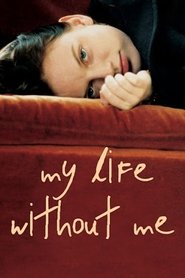
My Life Without Me (2003)
6.102/10
A fatally ill mother with only two months to live creates a list of things she wants to do before she dies without telling her family of her illness.
Release: 2003-03-07
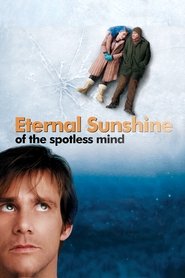
Eternal Sunshine of the Spotless Mind (2004)
8.1/10
Joel Barish, heartbroken that his girlfriend underwent a procedure to erase him from her memory, decides to do the same. However, as he watches his memories of her fade away, he realises that he still loves her, and may be too late to correct his mistake.
Release: 2004-03-19
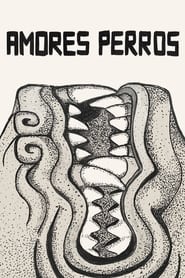
Amores Perros (2000)
7.6/10
A fatalistic car crash in Mexico city sets off a chain of events in the lives of three people: a supermodel, a young man wanting to run off with his sister-in-law, and a homeless man.
Release: 2000-06-16
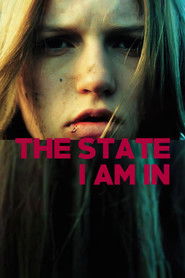
The State I Am In (2001)
6.8/10
Clara and Hans are left-wing terrorists who have been sought by police for almost fifteen years. Their increasingly rebellious daughter Jeanne begins to pose a threat to their security when she falls in love with a boy she meets on the beach.
Release: 2001-02-01

Paradise Now (2005)
6.9/10
Two childhood friends are recruited for a suicide bombing in Tel Aviv.
Release: 2005-09-07
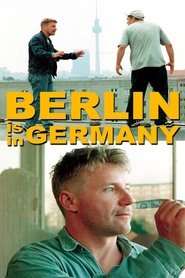
Berlin is in Germany (2001)
5.4/10
When Martin, a former GDR citizen, is released from jail, he lately becomes confronted with the consequences of the German re-unification.
Release: 2001-11-01
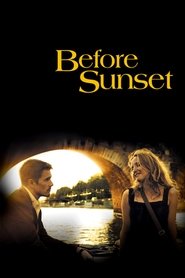
Before Sunset (2004)
7.807/10
Nine years later, Jesse travels across Europe giving readings from a book he wrote about the night he spent in Vienna with Celine. After his reading in Paris, Celine finds him, and they spend part of the day together before Jesse has to again leave for a flight. They are both in relationships now, and Jesse has a son, but as their strong feelings for each other start to return, both confess a longing for more.
Release: 2004-06-16
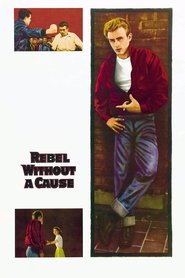
Rebel Without a Cause (1955)
7.494/10
After moving to a new town, troublemaking teen Jim Stark is supposed to have a clean slate, although being the new kid in town brings its own problems. While searching for some stability, Stark forms a bond with a disturbed classmate, Plato, and falls for local girl Judy. However, Judy is the girlfriend of neighborhood tough, Buzz. When Buzz violently confronts Jim and challenges him to a drag race, the new kid's real troubles begin.
Release: 1955-10-27
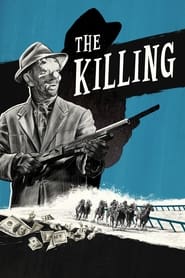
The Killing (1956)
7.645/10
Career criminal Johnny Clay recruits a sharpshooter, a crooked police officer, a bartender and a betting teller named George, among others, for one last job before he goes straight and gets married. But when George tells his restless wife about the scheme to steal millions from the racetrack where he works, she hatches a plot of her own.
Release: 1956-06-06
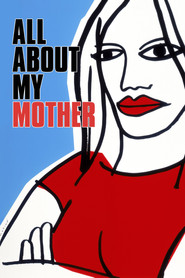
All About My Mother (1999)
7.613/10
Following the tragic death of her teenage son, Manuela travels from Madrid to Barcelona in an attempt to contact the long-estranged father the boy never knew. She reunites with an old friend, an outspoken transgender sex worker, and befriends a troubled actress and a pregnant, HIV-positive nun.
Release: 1999-04-16
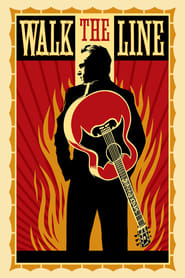
Walk the Line (2005)
7.5/10
A chronicle of country music legend Johnny Cash's life, from his early days on an Arkansas cotton farm to his rise to fame with Sun Records in Memphis, where he recorded alongside Elvis Presley, Jerry Lee Lewis and Carl Perkins.
Release: 2005-09-13
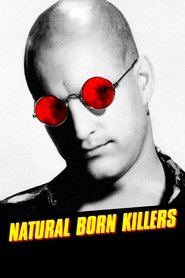
Natural Born Killers (1994)
7.056/10
Two victims of traumatized childhoods become lovers and serial murderers irresponsibly glorified by the mass media.
Release: 1994-08-26

Italian for Beginners (2000)
6.4/10
Several lonely hearts in a semi-provincial suburb of a town in Denmark use a beginner's course in Italian as the platform to meet the romance of their lives. The film, which unspools the connections and family drama shared between the students, complies with several aesthetic principles of Dogme 95 movement.
Release: 2000-12-07
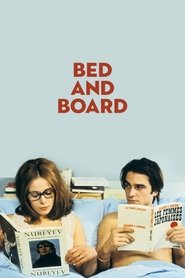
Bed and Board (1970)
7.1/10
Parisian everyman Antoine Doinel has married his sweetheart Christine Darbon, and the newlyweds have set up a cozy domestic life of selling flowers and giving violin lessons while Antoine fitfully works on his long-gestating novel. As Christine becomes pregnant with the couple's first child, Antoine finds himself enraptured with a young Japanese beauty. The complications change the course of their relationship forever.
Release: 1970-09-09
No End (1985)
6.95/10
1982, Poland. A translator loses her husband and becomes a victim of her own sorrow. She looks to sex, to her son, to law, and to hypnotism when she has nothing else in this time of martial law when Solidarity was banned.
Release: 1985-06-17
The Good German (2006)
5.811/10
An American journalist arrives in Berlin just after the end of World War Two. He becomes involved in a murder mystery surrounding a dead GI who washes up at a lakeside mansion during the Potsdam negotiations between the Allied powers. Soon his investigation connects with his search for his married pre-war German lover.
Release: 2006-12-15
Before Sunrise (1995)
7.972/10
An unexpected meeting on a train leads two travelers to spend an evening wandering through Vienna. As the night unfolds, they share stories and conversations about life and love, exploring new ideas while a quiet intimacy grows between them, knowing it may be their only night together.
Release: 1995-01-27
Talk to Her (2002)
7.57/10
Two men share an odd friendship while they care for two women who are both in deep comas.
Release: 2002-03-15

Dead Poets Society (1989)
8.299/10
At an elite, old-fashioned boarding school in New England, a passionate English teacher inspires his students to rebel against convention and seize the potential of every day, courting the disdain of the stern headmaster.
Release: 1989-06-02
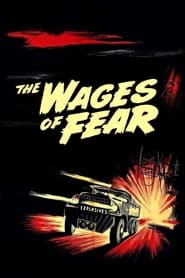
The Wages of Fear (1953)
8.006/10
In a run-down South American town, four men are paid to drive trucks loaded with nitroglycerin into the jungle through to the oil field. Friendships are tested and rivalries develop as they embark upon the perilous journey.
Release: 1953-04-22